Polo View Tongas & Pahalgam Bus Stand in Old Kashmir Photos
A collection of old photographs and a painting showing everyday streets, public spaces, and quiet moments in Srinagar, Pahalgam, and Sonamarg from the 1860s to the 1980s. The pictures include a horse-drawn tonga on Polo View in Srinagar during the 1970s with passengers and pedestrians; a poplar-lined avenue near Rambagh around 1880 with walkers; Barbar Shah Bridge over a waterway in early 20th century Srinagar with moored boats; a panoramic view of Gojwara neighborhood from Jamia Masjid minarets in mid-20th century; children in traditional clothing by a riverbank in 1976; the busy bus stand at Pahalgam in the 1980s with passengers boarding; a 1913 painting "Mother and Child, Kashmir" by Charles W. Bartlett near Dal Lake; a narrow lane in old Srinagar in 1902; the camping ground at Sonamarg in early 20th century; and a crowded stone arch bridge in Srinagar from the 1860s albumen print. Simple views of old Kashmir.

A color photograph from the 1970s captures a horse-drawn tonga making its way through the open expanse of Polo View in Srinagar, Kashmir, the sturdy pony pulling the covered carriage with passengers seated inside, driver perched at the front, while a few pedestrians in woolens cross the wide, unpaved road nearby, vintage cars parked along the edges and a central traffic island marked "KEEP LEFT," framed by bare winter trees, low-rise buildings including a signboard for a surgical company, and the soft silhouette of snow-dusted mountains rising in the hazy distance under a pale sky, offering a tender nostalgic snapshot of the valley’s transitional urban streets, lingering traditional transport, mix of everyday pedestrians and vehicles, and spacious surroundings during the 1970s, before rapid modernization altered the city’s character.

A historic photograph from around 1880 captures the graceful, tree-lined avenue of tall poplars near Rambagh in Srinagar, Kashmir, where a long, straight dirt road stretches into the soft distance, flanked by dense rows of slender trees forming a natural arcade overhead, a modest thatched-roof shelter with simple wooden frame and mud walls stands roadside on the left, while small groups of pedestrians—women in long traditional garments and children—walk along the path hand-in-hand or carrying bundles, the open pastoral landscape fading gently into haze beyond, offering a tender nostalgic snapshot of the valley’s early rural thoroughfares, harmonious blend of nature and human presence, characteristic roadside structures, and peaceful everyday movement during the late 19th century.

An early 20th century photograph captures the peaceful, verdant riverscape around Barbar Shah Bridge in Srinagar, Kashmir, where a delicate lattice-railed wooden bridge spans the narrow, tree-fringed waterway, numerous shikara and doonga boats clustered along both muddy banks with their canopies lowered and oars at rest, a single figure poling a small boat in the midstream, the calm water mirroring the overhanging branches of tall trees and the gentle, forested hills rising softly in the background, offering a tender nostalgic snapshot of the valley’s intimate riverfront settings, traditional boat-based transport, lush natural surroundings, and serene everyday waterside life during the early decades of the century.

A mid-20th century photograph taken from the minarets of the Jamia Masjid captures the expansive vista over the Gojwara area of Srinagar, Kashmir, where densely clustered traditional Kashmiri houses—multi-storied with brick-and-timber construction, latticed windows, overhanging balconies, and pitched roofs—spread across the sloping terrain in an intricate patchwork of narrow lanes and courtyards, a few winding roads threading through the neighborhood, patches of green trees and gardens interspersed among the rooftops, while the dramatic silhouette of Hari Parbat Fort crowns the rocky hilltop rising sharply in the background against layered Himalayan ranges under a vast, softly clouded sky, offering a tender nostalgic snapshot of the valley’s historic urban sprawl, distinctive vernacular residential architecture, harmonious integration with the surrounding hills, and timeless sense of place during the mid-20th century.
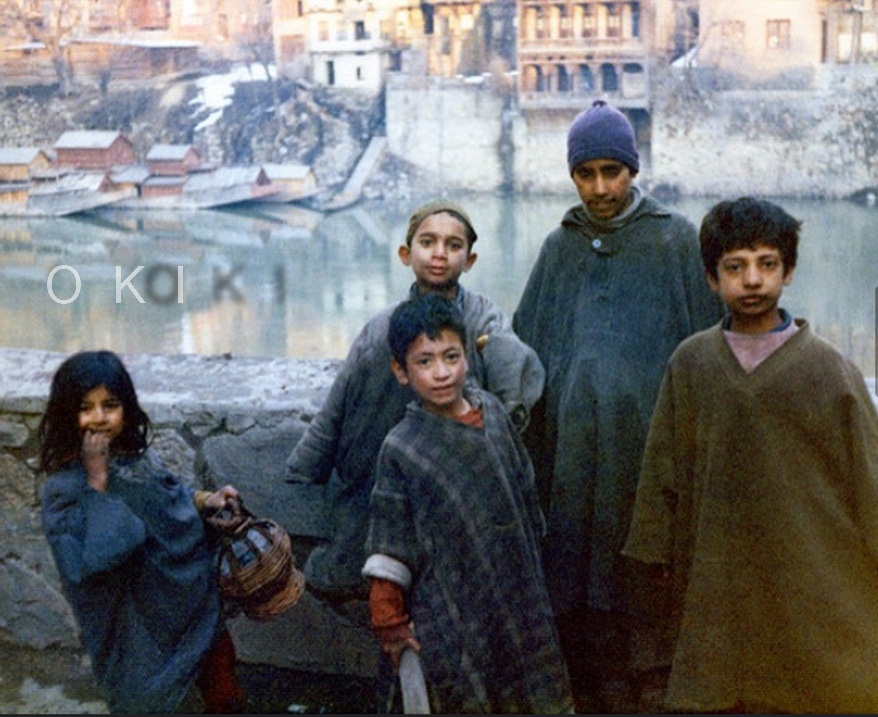
This 1976 color photograph shows a group of Kashmiri children standing near a riverbank in Srinagar, dressed in traditional woolen pherans and caps to ward off the winter chill, with one child holding a small basket and another a stick, posing casually against the backdrop of the calm waterway reflecting densely packed traditional wooden houses with snow-dusted roofs climbing the hillside. The scene captures everyday life for young residents in mid-1970s Kashmir, where children often helped with household chores or played along the Jhelum River or canals that threaded through the city's neighborhoods, surrounded by the distinctive multi-story brick-and-timber architecture that characterized Srinagar's historic riverfront settlements during a period of relative peace and cultural continuity.

This 1980s color photograph shows the bustling bus stand at Pahalgam in Kashmir, a popular tourist destination and trekking base in the Lidder Valley, where passengers in traditional pherans and headscarves wait or board a white-and-blue public bus amid a crowded scene of locals, travelers, children, and even a cow wandering freely on the dusty ground. The image reflects everyday public transport activity in rural Kashmir during the mid-to-late 20th century, when buses served as the primary link between remote valleys like Pahalgam and Srinagar, facilitating movement for residents, pilgrims, and tourists in an era when road infrastructure was expanding but still shared space with animals and pedestrian traffic, capturing the lively, unhurried rhythm of daily life at this key transit point.

This 1913 painting titled "Mother and Child, Kashmir" by British artist Charles W. Bartlett portrays a tender scene of a Kashmiri woman in traditional blue pheran and white headscarf, adorned with large hoop earrings and a turquoise necklace, gently cradling her sleeping child dressed in green against a serene backdrop of Dal Lake with blooming lotus flowers and misty mountains. Executed in Bartlett's distinctive style blending Western techniques with Eastern subjects during his travels in Asia, the work captures the quiet intimacy of motherhood amid Kashmir's iconic natural beauty, reflecting the artist's fascination with the valley's people and landscapes in the early 20th century when Western painters often depicted idealized, peaceful portraits of local life.

This black-and-white photograph from 1902 shows a narrow lane in old Srinagar, Kashmir, flanked by traditional multi-story houses built with stone lower walls and wooden upper structures featuring overhanging balconies, small windows with shutters, and sloping roofs, some with grass growing on top for insulation. The unpaved alley curves gently uphill, with a lone figure walking away in the distance and shadows cast by the tall buildings under bright sunlight, while simple wooden doors and verandas suggest everyday residential use. The image documents the dense, organic urban fabric of early 20th-century Srinagar, where narrow lanes between closely packed homes formed the backbone of neighborhood life in the city's historic quarters before wider roads and modern construction altered the traditional layout.

This early 20th-century black-and-white photograph shows the camping ground at Sonamarg in the Sind Valley, Kashmir, a vast open meadow surrounded by dense pine forests and towering snow-capped Himalayan peaks dominating the skyline, with a lone figure in traditional attire standing on the grassy plain to give scale to the dramatic landscape. Known as the "Meadow of Gold" for its summer wildflowers, Sonamarg served as a popular high-altitude camping and trekking base during the British colonial era and early tourism period, offering visitors tented accommodation amid pristine alpine scenery before permanent hotels and modern facilities were developed, documenting the site's raw natural beauty and isolation that made it a favored stop on routes to higher glaciers and passes.

This rare 1860s albumen print photograph shows a stone arch bridge spanning a waterway in Srinagar, Kashmir, crowded with locals in traditional pherans and turbans crossing or standing on the structure, while wooden multi-story houses with overhanging balconies line both sides and a small boat passes underneath on the calm river below. The single high arch and robust stone construction identify it as one of Srinagar's historic bridges over the Jhelum River or a major canal, part of the city's famous seven ancient bridges that facilitated pedestrian and light traffic in the old quarters. The image documents the dense urban riverine life of mid-19th-century Srinagar, where bridges served as vital social and commercial hubs amid closely packed timber-and-brick residences before modern concrete replacements altered many of these iconic structures.
I believe Bakshi Stadium was built much before 1970 !
ReplyDelete